
As a critical raw material for lithium‑ion cathode precursors and solid‑state electrolytes, lithium phosphate powder features large specific surface area and poor flowability. Direct compaction often causes powder segregation, excessive fine particles and inconsistent granule strength.
Frequent material transfer between separate mixing and granulating devices in lab trials leads to material loss and batch‑to‑batch deviation, which distorts formulation test data. R&D teams demand integrated lab equipment to conduct mixing and granulation in one chamber, enabling fast tuning of additive dosage, speed sequence and liquid feeding timing to accelerate formulation iteration.
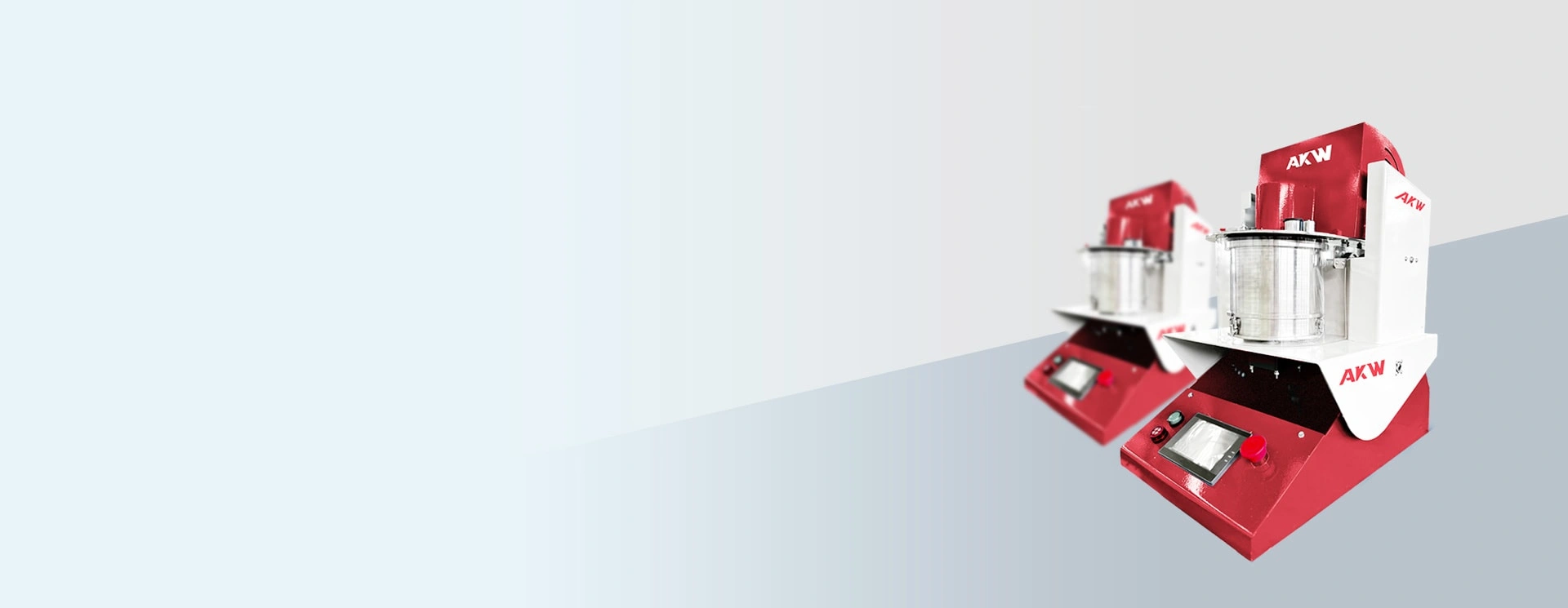
The AKW R04 lab‑scale mixer‑granulator is purpose‑built for new inorganic material R&D. With a 25‑litre batch capacity, it supports continuous two‑step processing within a single machine and serves as an ideal unit for lithium phosphate granulation experiments.
This lithium phosphate granulation test adopts the AKW R04 lab‑scale mixer‑granulator with 25L effective batch volume. Mixing and granulation are fulfilled inside the same chamber without tank switching or material transfer, avoiding component loss and cross‑contamination during material handling.
The full workflow runs continuously inside AKW R04. Only rotor‑speed adjustment triggers nucleation, growth and shaping, removing the requirement for multi‑unit serial configuration.
Beyond lithium phosphate granulation, the AKW R04 lab‑scale mixer‑granulator supports wet‑granulation formulation development for lithium‑ion powders, ceramic materials, molecular sieves, refractory raw materials and other inorganic powders. Pre‑mixing, spheronisation and granule shaping are completed on one machine to lower capital investment for new‑material laboratories.
Lab‑scale lithium phosphate granulation is constrained by homogeneous powder dispersion and precise granulation sequence control. Featuring 25L‑batch two‑step in‑machine workflow, the AKW R04 lab‑scale mixer‑granulator executes high‑speed pre‑mixing and three‑stage variable‑speed granulation within one unit. It reliably produces lithium phosphate granules with controllable particle size and superior sphericity, delivering robust equipment support for lithium‑ion new‑material formulation development and process validation.
FAQ
Q: Can mixing and granulation be completed in one AKW R04 unit?
A: Yes. The AKW R04 integrated design enables high‑speed mixing of powder and additives, followed by sequential medium‑high‑low speed granulation without material transfer.
Q: What is the batch capacity of AKW R04 granulator?
A: 25 litres per batch, suitable for lab‑scale trials and formulation iteration of lithium phosphate and various inorganic powders.
Q: How does three‑stage variable‑speed granulation work?
A: Medium speed for seed nucleation, high speed for granule growth and densification, low speed for shaping and polishing to optimise sphericity and particle‑size distribution of lithium phosphate granules.


Copyright © 2026 by Qingdao AKW Technology Co.,Ltd. All Rights Reserved
Privacy Policy