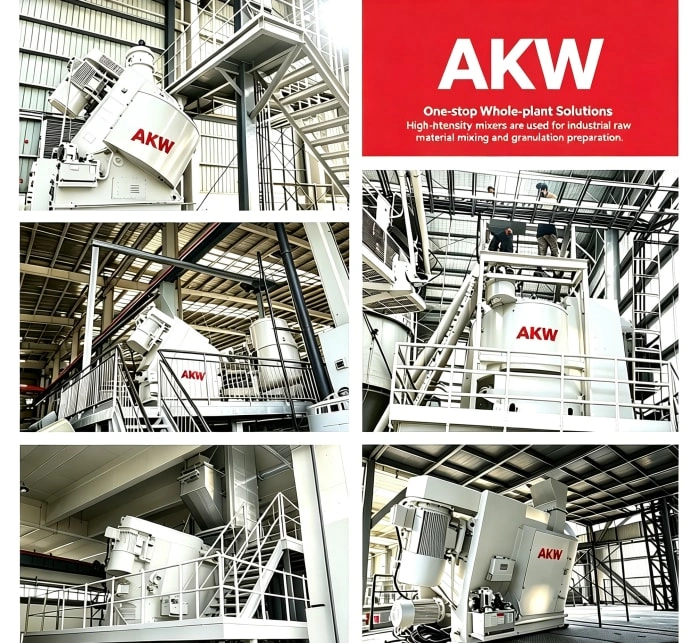
1. Core Working Principle Differences: Intensive Mixer vs Ordinary Mixer
1.1 Working Mechanism of Ordinary Mixer: Basic Convection Mixing
Ordinary mixers are conventional industrial mixing machines that rely entirely on low-speed mechanical convection and simple tumbling to mix materials. Common types include paddle mixers, ribbon blenders and basic planetary stirrers, which are designed for low-demand mixing scenarios. The equipment pushes raw materials to flow through blade rotation, with extremely weak shear force and no effective turbulence cutting effect.
The biggest flaw of the ordinary mixer’s working principle is the widespread mixing dead zones in the tank. Materials only produce simple layered flow, and agglomerated powder lumps cannot be broken up. This leads to uneven mixing, material stratification and inconsistent ingredient proportion, which is unable to meet high-precision industrial production standards.
1.2 Working Mechanism of Intensive Mixer: High-Shear Intensive Circulation Mixing
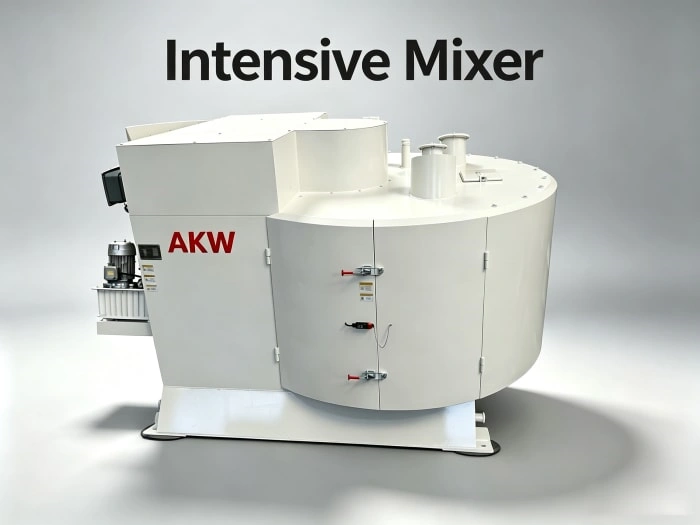
Different from ordinary mixers, the intensive mixer is a high-efficiency high-shear mixing equipment that separates material conveying and intensive mixing functions. It adopts a dual motion design of rotating pan and high-speed rotor, realizing full-volume three-dimensional closed-loop circulation of materials.
The rotor of the intensive mixer generates adjustable strong shear force, violent turbulence, impact and friction in the mixing tank. It can thoroughly crush ultra-fine powder agglomerates and uniformly fuse multi-component materials. Without any mixing blind spots, it integrates mixing, granulation, coating and compaction in one process, which is the core advantage that ordinary mixers cannot match.
2. Mixing Performance Comparison: Intensive Mixer vs Ordinary Mixer
2.1 Mixing Efficiency & Cycle Time of Ordinary Mixer and Intensive Mixer
Mixing cycle time is the most intuitive indicator to distinguish intensive mixer and ordinary mixer. Restricted by low-speed convection working mode, ordinary mixers require 30–90 minutes to complete a single batch of mixing, with extremely low hourly production throughput, which easily becomes the bottleneck of industrial production lines.
In contrast, AKW intensive mixers rely on high-shear turbulence circulation, completing a full standard mixing batch in only 60–300 seconds. The efficiency is more than 20 times higher than that of ordinary mixers, greatly improving workshop production capacity and shortening production cycles.
2.2 Mixing Uniformity & Precision of Intensive Mixer and Ordinary Mixer
Ordinary mixers can only achieve 75%–85% mixing homogeneity, with obvious material stratification and ingredient deviation. For production scenarios requiring precise formula ratio, ordinary mixing equipment is prone to unqualified finished products and material waste.
As professional high-precision mixing equipment, AKW intensive mixers support ultra-uniform mixing with a homogeneity rate of ≥99% and ingredient deviation controlled within ±1%. It can perfectly mix materials with large density and particle size differences, ensuring stable and consistent product quality in mass production.
2.3 Shear Force & Agglomerate Breaking Capacity of Two Mixers
The shear rate of ordinary mixers is lower than 500 s⁻¹, with almost no lump breaking ability. When handling damp, sticky and agglomerated powders, a large number of material lumps remain, resulting in incomplete mixing and failing to meet production requirements.
The AKW intensive mixer has an adjustable shear rate of 10,000–50,000 s⁻¹, which can efficiently crush various ultra-fine powder agglomerates and sticky material clusters. This core performance makes intensive mixers uniquely suitable for high-end fine chemical and new material production.
3. Energy Consumption & Operating Cost: Intensive Mixer vs Ordinary Mixer
3.1 Power Consumption Comparison of Ordinary Mixer and Intensive Mixer
Long-term low-speed continuous operation leads to high energy consumption of ordinary mixers, with power consumption reaching 40–60 kWh per ton of materials. Long-term operation will generate huge electricity costs for enterprises.
Although the AKW intensive mixer is equipped with a high-power motor, its ultra-short mixing cycle greatly reduces comprehensive energy consumption. The power consumption per ton of materials is only 15–25 kWh, saving 60%–70% of electricity compared with ordinary mixers, with prominent energy-saving benefits.
3.2 Maintenance & Service Life Cost of Intensive Mixer and Ordinary Mixer
Ordinary mixers have serious material sedimentation in dead zones, resulting in uneven wear of blades and tank body. Frequent cleaning and parts replacement are required, with high maintenance frequency and short equipment service life, increasing enterprise operating costs.
The full-circulation design of AKW intensive mixers avoids material residue and dead zone wear. The wearing parts bear uniform load, with longer service life and lower daily maintenance workload. It effectively reduces long-term operation and maintenance costs for production enterprises.
4. Material Adaptability: Application Scenarios of Intensive Mixer and Ordinary Mixer
4.1 Suitable Processing Materials for Ordinary Mixer
Ordinary mixers are only applicable to low-difficulty and low-precision mixing scenarios. They can only handle low-viscosity dry powders with similar particle density and uniform particle size, such as common construction sand and gravel, ordinary dry mortar, animal feed and grain raw materials.
This type of mixer has obvious limitations: it cannot process ultra-fine nano powder, high-viscosity sticky slurry, and multi-component materials with large density differences, and is completely unable to meet high-end material processing needs.
4.2 Suitable Processing Materials for Intensive Mixer
As a multi-functional high-end mixing equipment, AKW intensive mixers cover all materials applicable to ordinary mixers, and are more suitable for various difficult-to-process industrial raw materials. It is the core equipment for high-precision material mixing in modern manufacturing industry.
Its main applicable materials include: refractory raw materials, ceramic and glass powder, lithium battery electrode powder, metallurgical powder, welding flux, high-viscosity adhesive slurry and multi-component formula materials with large density differences.
5. Industrial Application Fields: Intensive Mixer vs Ordinary Mixer
5.1 Industrial Application Scope of Ordinary Mixer
Due to limited mixing performance and precision, ordinary mixers are only used in low-end, low-standard industrial production fields. The main application scenarios include civil construction aggregate mixing, ordinary feed processing, low-grade plastic filler blending and daily food grain mixing, with low industry threshold and single application.
5.2 Industrial Application Scope of Intensive Mixer
IAKW intensive mixers with high efficiency and high precision are widely used in high-end precision manufacturing industries, becoming essential core equipment for many industrial production lines. Its main application fields cover refractory industry, new energy lithium battery raw material processing, ceramic glass manufacturing, powder metallurgy, high-grade building materials and fine chemical industry.
6. FAQ for Intensive Mixer vs Ordinary Mixer
6.1 Can an AKW intensive mixer replace an ordinary mixer for daily simple mixing?
Yes. The intensive mixer supports adjustable speed switching, which can not only realize high-shear intensive fine mixing, but also simulate the low-speed gentle mixing mode of ordinary mixers. It can fully cover all working scenarios of ordinary mixers, with stronger versatility.
6.2 Is the comprehensive use cost of AKW intensive mixer higher than ordinary mixer?
No. Although the initial purchase cost of intensive mixers is slightly higher, its ultra-low energy consumption, low maintenance cost and high production efficiency can help enterprises save a lot of operating costs. Most manufacturers can recover the equipment premium cost within 6–12 months, with higher long-term cost performance than ordinary mixers.
6.3 How to choose between intensive mixer and ordinary mixer for production?
If you only need simple low-precision mixing of conventional materials with low production requirements, an ordinary mixer can meet the demand. If your production involves ultra-fine powder, sticky slurry, multi-component differential density materials, and requires high uniformity and high yield, an intensive mixer is the only cost-effective choice.
7. Conclusion: Core Differences Between Intensive Mixer and Ordinary Mixer
In summary, the essential difference between intensive mixer and ordinary mixer lies in the mixing mechanism and core performance. The ordinary mixer is a basic industrial mixing machine based on simple convection stirring, with low efficiency, low precision and single function, only suitable for low-standard simple mixing work.
The intensive mixer is a high-performance high-shear mixing equipment with three-dimensional circulation and intelligent adjustable shear force, featuring high mixing efficiency, ultra-high uniformity, energy saving and multi-process integration. It is the preferred equipment for high-end, high-precision and high-yield industrial material mixing production, and has become the mainstream choice of modern industrial mixing technology.