1. Working Principle of Inclined Intensive Mixer
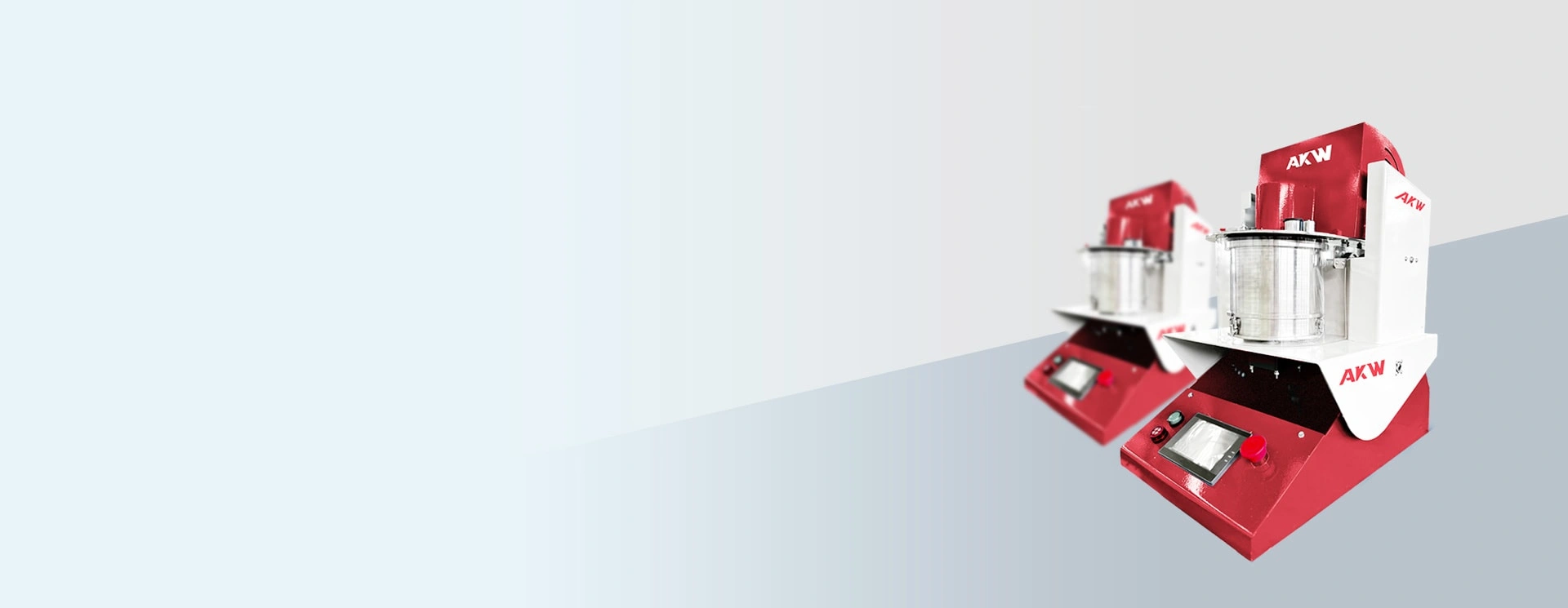
AKW lab inclined intensive mixer adopts a fixed 0°,10°,20°,30° inclined barrel structure, combined with high-speed eccentric rotor rotation and stationary wall scrapers to form a unique 3D turbulent mixing field. Different from the vertical planetary mixer’s revolution and rotation mode, it realizes material mixing through gravity falling, centrifugal lifting and uniform shear dispersion.
This adjustable low-to-medium shear design effectively breaks nano-agglomeration of Li₂S-P₂S₅ and LPSC sulfide solid electrolyte powders. It completely avoids severe impact force of ball mills, protecting the complete crystal structure and stable ionic conductivity of sensitive sulfide materials. After mixing, the inclined barrel completes discharging with extremely low powder residue.
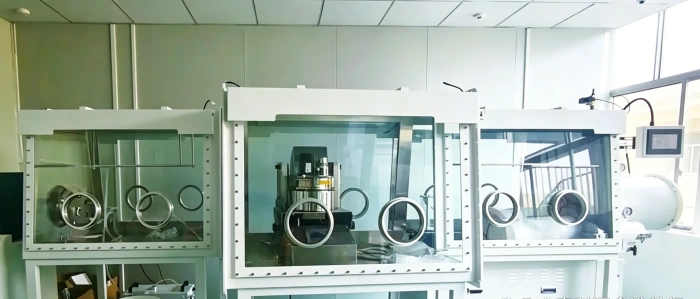
Customized for glove box installation, the equipment adopts a separated structure. All power motors and external controllers are placed outside the glove box, while only the mixing barrel and stirring rotor are installed inside the argon-filled glove box. The flange penetrating sealing structure greatly reduces internal occupation space, perfectly matching the internal size of standard laboratory glove boxes.
2. Glove Box Customized Structural Design (Sulfide Electrolyte Exclusive)
2.1 Compact Lab Size
Available in lab volumes of 0.5L, 1L, 2L and 5L..which can be smoothly transferred through the glove box transition chamber. All electrical control systems, frequency converters and water cooling units are arranged externally to save internal glove box space.
2.2 Metal Contamination-Free Material Configuration
To solve the core pain point of sulfide electrolyte degradation caused by metal ion precipitation, all material contact parts including the barrel, rotor and wall scrapers adopt high-purity and corrosion-resistant materials. The priority configuration is SiC (Silicon Carbide) coating, followed by high-purity TA2 titanium and zirconia ceramic lining, with ordinary 304/316 stainless steel completely prohibited.
The inner wall adopts mirror polishing with Ra≤0.4μm and full arc transition design without dead corners, preventing sulfide powder adhesion. The fully sealed barrel supports the whole process of feeding, dry mixing and discharging under pure argon atmosphere inside the glove box, isolating air and moisture to avoid sulfide hydrolysis and toxic H₂S gas generation.
2.3 Precision Constant Temperature Water Cooling System
The mixing barrel is equipped with a jacket water cooling structure, with cooling pipes penetrating the glove box and connected to an external constant temperature unit. It achieves a precise temperature control accuracy of ±2℃, limiting the temperature rise of the mixing cavity within 4-5℃ during long-term operation. This effectively prevents thermal degradation of sulfide solid electrolytes and ensures stable ionic conductivity of materials.
2.4 Professional Penetration Transmission & Sealing Solution
The drive shaft adopts a wall-penetrating flange isolation structure, placing all heat-generating motors outside the glove box to avoid internal temperature fluctuation and pollution. The shaft end is equipped with fluororubber inflation sealing, with trace argon gas continuously filled to prevent internal powder from entering the bearing and block external air infiltration, stably maintaining the internal water and oxygen content below 1ppm.
The rotor speed is 0-300rpm frequency adjustable. Low speed is suitable for compound mixing of electrolyte powder, conductive carbon and binder, while medium speed is applied for uniform powder pre-dispersion. Adopting full dry powder mixing without any grinding media, it completely protects the crystal integrity of sulfide electrolytes.
3. Advantages & Disadvantages vs Vertical Planetary Intensive Mixer
3.1 Core Advantages of Inclined Glove Box Mixer
Ultra-low residue & easy cleaning: The inclined flipping discharging structure leaves powder residue less than 0.3% inside the narrow glove box. It is more convenient to clean and replace formulas frequently, greatly improving laboratory R&D efficiency.
Uniform powder dispersion: The unique inclined gravity flow field solves the stratification problem of high-density sulfide electrolyte powder and lightweight conductive carbon powder, achieving a mixing uniformity CV value ≤3%.
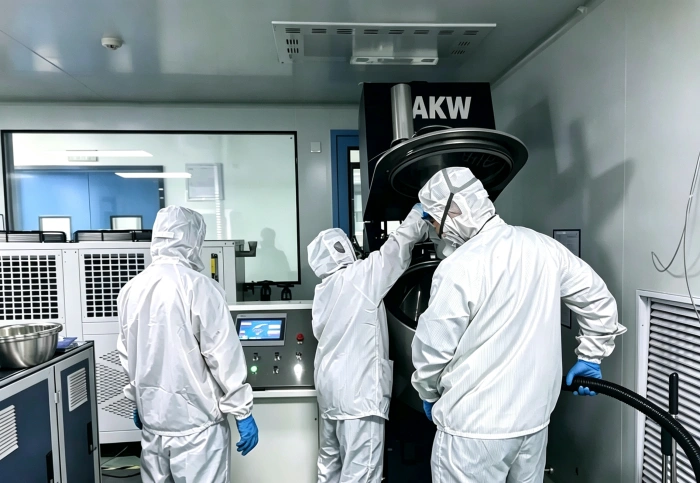
100% scalable process: The rotor linear speed and flow field logic of 0.5-5L lab inclined mixers are completely consistent with 20-1000L mass production models. Lab formula parameters can be directly transferred to industrial equipment, minimizing process scaling risks.
Simplified internal structure: No complex revolution mechanism inside the glove box, fewer wearing parts, effectively reducing internal contamination risks and later maintenance costs.
3.2 Limitations
Under the same volume specification, the inclined mixer occupies a larger floor area, which may cause space constraints in small glove boxes (width <700mm). Besides, its maximum shear force is lower than vertical planetary mixers, so it cannot meet the mechanical chemical reaction requirements of Li₂S-P₂S₅ precursor synthesis.
3.3 Selection Guide
Priority selection: Suitable for dry compound mixing of sulfide electrolyte powder and cathode-electrolyte composite powder (no mechanical synthesis required).
Alternative selection: Zirconia tank planetary ball mill is recommended for mechanical chemical synthesis of sulfide electrolyte precursors.
4. Standard Process Parameters for Sulfide Dry Mixing
-
Filling coefficient: 45%-65%
-
Rotor speed range: 80-180rpm
-
Mixing time: 8-15 minutes
-
Working environment: Pure argon atmosphere, water & oxygen content <1ppm
-
Optional function: External vacuum pump pipeline supports vacuum degassing before mixing, removing wrapped air inside powder to further improve mixing uniformity and material stability
5. Brand & Supply Overview
Domestic brands (CO-NELE,AKW): Mature customized wall-penetrating glove box mixers with reliable SiC coating and high-purity titanium cavity technology. Featuring high cost performance and stable performance, 0.5-5L lab models have been widely applied in domestic solid-state battery R&D laboratories.
Imported brands (EIRICH): Small inclined mixers have large overall volume, only applicable for oversized glove boxes, with a market price 2-3 times higher than domestic equipment.
FAQ
Q1: Why choose inclined intensive mixer for sulfide electrolyte mixing instead of ball mill?
Ball mills rely on high-intensity impact force which destroys sulfide crystal structures and reduces ionic conductivity. AKW inclined mixers adopt pure shear dispersion mixing without grinding media, which maintains complete crystal structure while ensuring uniform powder mixing, ideal for electrolyte compounding.
Q2: Can the lab mixing process be scaled up to mass production?
Yes. The flow field operation logic and core process parameters of lab-scale inclined mixers are fully consistent with industrial mass production models, realizing zero-difficulty process scaling and avoiding repeated formula debugging.
Q3: How to ensure no moisture and oxygen contamination during mixing?
The equipment adopts professional wall-penetrating inflation sealing, matched with glove box argon protection system, stably maintaining internal water and oxygen content below 1ppm. The fully sealed cavity isolates external air completely, preventing sulfide powder hydrolysis and failure.