July 15, 2026, Qingdao, China — Choosing a suitable intensive mixer heavily determines overall plant productivity and mixing quality for UHPC, refractory, ceramic and lithium‑battery manufacturers across Southeast Asia and Latin America. Most industrial purchasers focus on equipment price while ignoring production‑output‑based model selection rules. AKW’s engineering team summarizes practical formulas and regional‑oriented intensive mixer selection guidelines to help overseas customers avoid over‑investment or insufficient production capacity.
Why Production Output Becomes The Top Factor for Intensive Mixer Model Selection
Common mistakes when buyers ignore actual throughput
Improper model selection either limits daily production or causes excessive energy consumption. Most plant managers in Thailand, India, and Brazil often only refer to nominal volume rather than effective filling rate, resulting in 20‑30% loss of planned output. Unlike ordinary mixing equipment, professional AKW intensive mixers cannot operate at full volume loading. The professional AKW intensive mixer accommodates varying filling standards tailored to specific processes and industries: standard mixing operations support 100% full-load filling; granulation processes utilize an effective filling rate of 50%–70%; and the UHPC (Ultra-High Performance Concrete) industry adopts a standardized filling rate of 70%., which is a core index easily overlooked by global buyers.
Single‑batch capacity, mixing cycle time and daily working hours jointly determine the actual hourly production output. The universal calculation formula for intensive mixer model selection is as follows:
Hourly production = single‑batch weight × 60 ÷ total mixing‑cycle time
Key parameters linked with production‑based model selection
To achieve accurate model matching, manufacturers in Southeast Asia and Latin America need to confirm four core parameters before selection, ensuring the equipment matches long‑term production demands:
1. Single‑batch rated capacity (liter or kg)
2. Full mixing cycle period (charging‑mixing‑discharging, normally 60‑180 seconds for high‑shear intensive mixers)
3. Daily running hours and annual working days of the production line
4. 3‑5 years future capacity expansion plan for the factory
Step‑by‑Step Calculation Process to Match Intensive Mixer Models with Target Output
Step1: Confirm real‑world production‑target data
Distinguish between theoretical maximum output and actual on‑site production demand, and classify matching intensive mixer models according to different production scales, covering laboratory research, medium factory production and large‑scale continuous production scenarios:
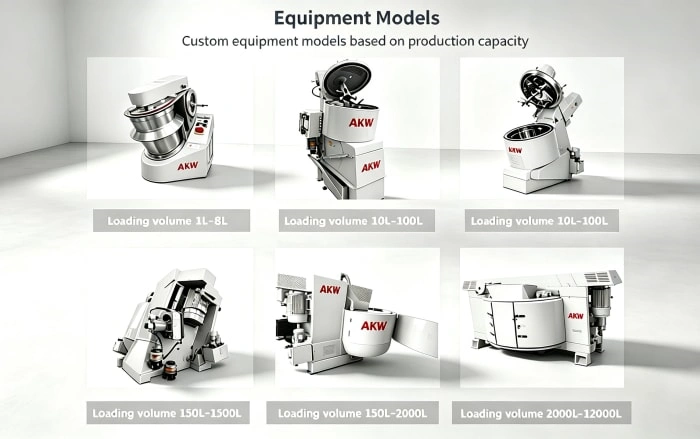
- Small‑batch R&D: hourly output below 500kg → laboratory‑type intensive mixer (1L‑100L models)
- Medium‑scale factory production: 1‑10 tons per hour → medium‑size intensive mixers from 150L‑600L
- Mass‑volume continuous production: above 10 tons/hour → heavy‑duty 800‑2500L intensive mixer models for refractory, UHPC, lithium‑ion powder production lines
A typical application case of AKW intensive mixers from a Thai UHPC precast factory verifies the importance of accurate calculation. The factory set a target output of 6 tons per hour with a 120‑second mixing cycle and 65% standard filling rate. According to the formula, the required single‑batch weight is 200kg, making AKW 300L intensive mixer the optimal choice. If the factory had selected a 200L model based on nominal volume, the actual hourly output would only reach 3.9 tons, completely failing to meet production targets.
Step2: Adjust model specification by material characteristics
Identical hourly output demands require different intensive mixer configurations due to diverse raw material properties, a key adjustment point frequently ignored by Latin American industrial buyers. Different materials bring varying mixing difficulty and equipment loss, requiring targeted model upgrading and configuration optimization:
- Abrasive refractory aggregates and UHPC dry mix: Adopt AKW low‑speed high‑torque intensive mixers equipped with customized wear‑resistant liners, and upgrade the model size by 15% to extend equipment service life and reduce frequent wear and tear.
- Lithium‑battery solid‑state electrolyte powder: Choose AKW high‑shear intensive mixer versions, and select models based on effective volume instead of nominal volume to avoid uneven powder dispersion and ensure ultra‑uniform mixing quality for new energy materials.
- Wet viscous paste: Properly lengthen the mixing cycle time and select one‑size‑larger intensive mixer model to guarantee full stirring and stable product quality.
Step3: Reserve capacity for future expansion
For long‑term factory layout and market expansion in Indonesia, Vietnam, Mexico and other emerging industrial markets, it is highly recommended to reserve 20‑30% surplus production capacity instead of purchasing fully matched models for current demands only.
AKW’s exclusive modular intensive mixer design supports independent drive system upgrades and functional expansion without replacing the whole equipment set. This flexible and cost‑effective configuration effectively reduces later‑stage equipment renovation costs and perfectly meets the growing production demand of Southeast Asian and Latin American manufacturers in the next few years.
Recommended Intensive Mixer Model Matching Table for Different Production‑Scale Projects
|
Hourly Output Range
|
Suggested Intensive Mixer Model Volume
|
Suitable Application & Target Regions
|
|
Less than 500kg/h
|
1‑100L
|
Lab test, small pilot line; Philippines, Malaysia
|
|
0.5‑10 Ton/h
|
150‑600L
|
Precast concrete, industrial ceramic; Thailand, India
|
|
10‑30 Ton/h
|
800‑1500L
|
Refractory material, dry mortar; Brazil, Chile
|
|
Over 30 Ton/h
|
1800‑7000L
|
Large‑scale UHPC and battery material production lines; Middle‑East market
|
Extra Supporting Configurations Decided by High‑Volume Production Demand
For continuous high‑output intensive mixing projects
When the hourly production output exceeds 15 tons, simply increasing the mixer volume cannot guarantee long‑term stable operation. Matching professional auxiliary configurations is essential for AKW large‑scale continuous intensive mixing production lines widely used in Southeast Asian and Middle Eastern industrial plants:
1. Automatic feeding system with loss‑in‑weight feeder to shorten charging time and improve overall production efficiency.
2. PLC intelligent control and IoT monitoring module to record full batch production data, realizing comprehensive production traceability and facilitating factory intelligent management.
3. High‑power frequency conversion motors to stabilize equipment operation under long‑term full‑load working conditions and reduce failure rates.
Final Takeaways for Global Buyers
Core principles for production‑based intensive mixer selection
To help global industrial buyers quickly complete accurate and cost‑effective intensive mixer model selection, the core selection principles are summarized as follows:
1. Calculate single‑batch volume strictly based on actual hourly output, and take 50‑70% effective filling factor as the unified selection standard.
2. Appropriately upgrade the model size by 15% for abrasive or sticky raw materials to adapt to special mixing scenarios.
3. Reserve about 25% surplus capacity for factories with future market expansion plans in Southeast Asia and South America.
4. Match professional auxiliary components according to production scale to ensure long‑term stable and high‑efficiency output of AKW intensive mixer production lines.
Contact our engineering teamLearn more customized AKW intensive mixer selection solutions for your production line. for professional calculation and one‑to‑one equipment configuration advice.