
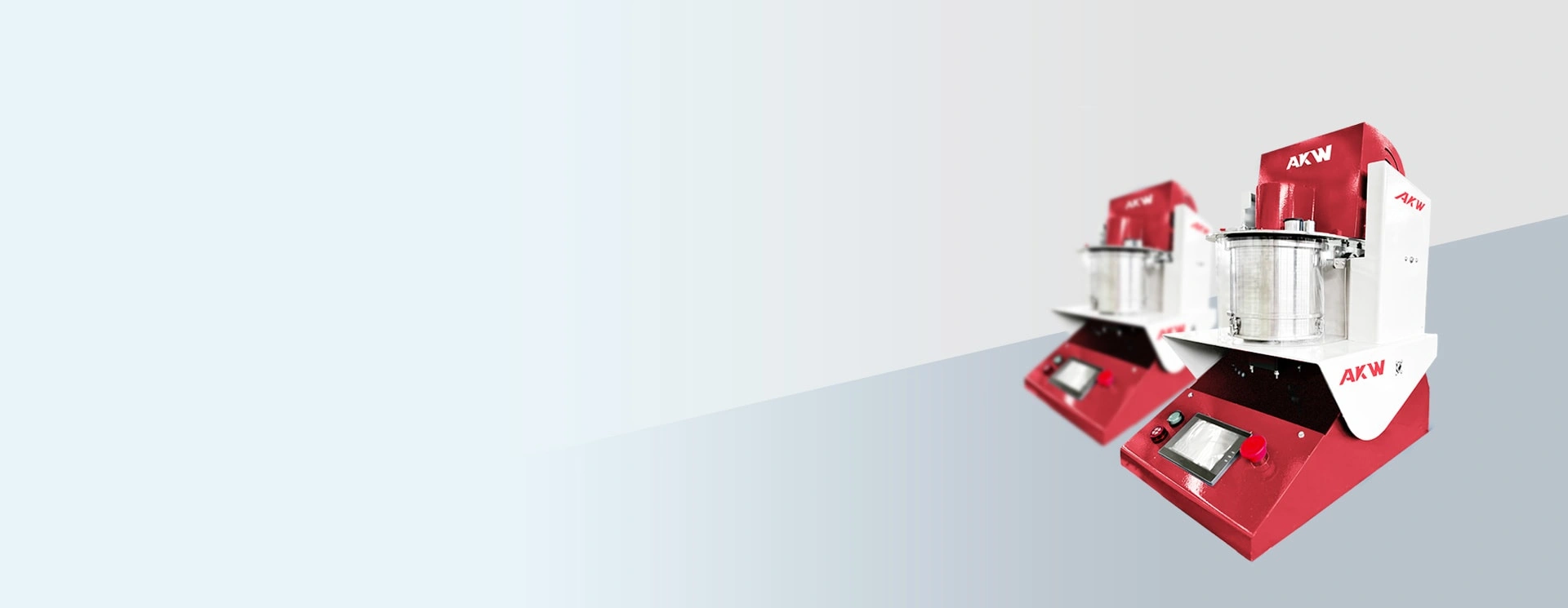
AKW Adsorbent Powder Granulation Test – EL1plus 2L Laboratory Intensive Mixer (0.3–0.8 mm Pellets, European Client Project)
We completed a custom adsorbent powder granulation trial for a client from Europe on the AKW EL1plus laboratory intensive mixer , working volume 2 L.
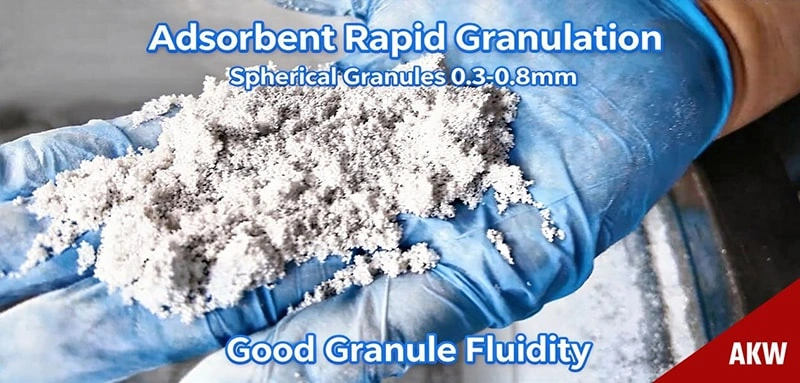
This test adopted a special staged feeding workflow: base powder charging first, followed by binder dosing, then continuous supplementary micro powder addition while mixing and granulation running. The target finished spherical pellet size is 0.3–0.8 mm , which is typical for adsorbent R&D, catalyst support, separation media and porous functional material development.
This flexible feeding strategy helps stabilize granule growth, avoid over-wetting, reduce oversized agglomerates and keep narrow particle size distribution, critical for adsorbent performance (specific surface area, pore structure and adsorption capacity). All test parameters are fully recordable and repeatable for later industrial scale-up on AKW production intensive mixers.
Adsorbent Powder Granulation Equipment Info
- Brand: AKW
- Model: EL1plus Lab Intensive Mixer
- Effective Volume: 2 L
- Process Function: dry mixing, binder dispersion, nucleation, controlled granule growth in one batch unit
- Control: adjustable rotor speed, mixing time, binder dosing rate, auxiliary powder feeding frequency
- Output: spherical adsorbent pellets, target size 0.3–0.8 mm
Granulation Process Flow (Client Custom Recipe)
1. Base powder loading : Charge the main adsorbent powder into the AKW mixing pan and start pre-mixing to obtain homogeneous dry powder.
2. Binder introduction : Metered binder liquid is injected/sprayed into the high-shear mixing zone to trigger powder nucleation.
3. Continuous supplementary powder feeding : While mixing and granulation proceed, small doses of fresh adsorbent powder are added incrementally. This suppresses excessive liquid bridge coalescence and controls granule growth rate.
4. Granulation stabilization : Maintain intensive mixing until pellets reach stable morphology and target particle window 0.3–0.8 mm.
5. Discharge & post-treatment : Discharge wet pellets for drying, sieving and performance characterization (crush strength, BET, pore volume, adsorption test).
Key Advantages of This Test & AKW EL1plus
Unique “continuous powder top-up” granulation method, proven by European adsorbent researcher on AKW equipment
AKW high-shear design enables precise control for fine pellet range 0.3–0.8 mm , hard to achieve by ordinary low-shear granulators
One-pot mixing + granulation, no material transfer segregation
2L small batch, low raw material consumption, perfect for high-value adsorbent R&D
Full parameter traceability, reliable scale-up reference for AKW pilot and production CR series intensive mixers
Suitable for silica, alumina, zeolite, activated carbon and other custom adsorbent powders
FAQ
Q1: Why add extra powder continuously during granulation instead of feeding all powder at once?
A: For the 0.3–0.8 mm fine pellet target, one-time full powder feeding easily causes local over-wetting, big lumps and wide PSD. Gradual supplementary powder balances liquid-solid ratio dynamically, slows granule merging and keeps narrow, stable particle distribution. This is a well-known technique used by European material labs for adsorbent and catalyst granulation, validated on AKW EL series lab mixers.
Q2: Can AKW EL1plus consistently hit 0.3–0.8 mm pellets for different adsorbent formulations?
A: Yes, with tuning of rotor speed, binder dosage, powder feeding rate and cycle time. The final size also depends on powder property, binder type and surface tension. AKW supports custom formulation tests and parameter optimization.
Q3: Is the test result scalable to larger AKW intensive mixer models?
A: AKW EL1plus follows the same counter-current intensive mixing principle as our production CR series. The process logic (binder dosing + incremental powder feeding) can be transferred to AKW pilot and industrial machines with proper scale-up calculation.
Q4: What adsorbent materials fit this granulation workflow on AKW EL1plus?
A: Zeolite, activated alumina, silica gel, activated carbon, molecular sieve and other porous adsorbent powders, also applicable for catalyst carrier, ceramic fine powder granulation.
Q5: Can AKW EL1plus adjust to other target pellet sizes besides 0.3–0.8 mm?
A: Yes. AKW EL1plus supports pellet ranges roughly from 0.2 mm up to several millimeters by changing shear intensity, liquid ratio and feeding strategy.
Q6: Is AKW EL1plus available for GMP or lab clean-room environments?
A: Contact our sales team for contact material options (stainless steel 316L, polishing treatment, jacket heating/cooling, sealed liquid spray system).


Copyright © 2026 by Qingdao AKW Technology Co.,Ltd. All Rights Reserved
Privacy Policy