
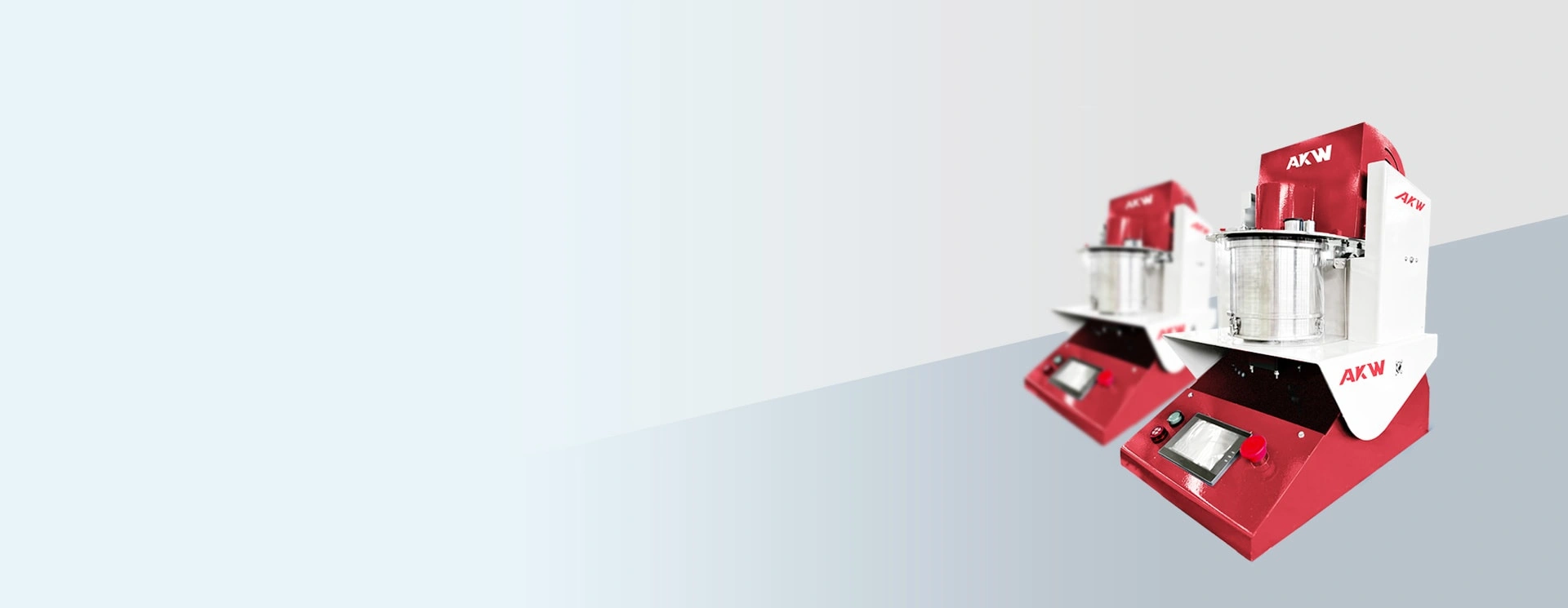
The production of brake pads and resin grinding wheels puts extremely strict requirements on powder homogenization. Brake pad formulations consist of steel fiber, aramid fiber, graphite, metal powder, phenolic resin, friction modifiers and dozens of other raw materials with huge differences in density and particle size. Resin grinding wheels are made of fused alumina, silicon carbide abrasive grains, resin binders and mineral fillers. Conventional mixers often suffer from powder segregation, resin agglomeration, fiber clumping and uneven distribution of trace additives. These defects lead to unstable friction coefficient, serious thermal fade of brake pads, inconsistent hardness of grinding wheels, high reject rate of green compacts.
To tackle these industry bottlenecks, AKW intensive mixer launches a specialized mixing & granulation integrated solution for friction materials and abrasive tools, serving brake pad manufacturers and resin grinding wheel factories worldwide.
AKW intensive mixer for brake pads and grinding wheels adopts 3D counter-current high-shear mixing technology. The combined turbulent flow generated by rotating vessel and high-speed rotors ensures all materials participate in mixing without dead zones. It breaks fiber bundles and electrostatic agglomerates within short mixing cycles, eliminates segregation between heavy metal powder and lightweight fiber powder. Trace lubricants, sulfides and coupling agents can be dispersed evenly at micro level, stabilizing batch-to-batch performance of brake pads and abrasive wheels.
Wear-resistant construction is critical for grinding wheel abrasive processing. Hard abrasive grains like alumina and silicon carbide cause severe abrasion to mixing chamber. AKW provides optional tungsten carbide wear liners and mixing tools to resist abrasion, reduce iron contamination and extend machine service life. The machine supports dry mixing, liquid spraying coating and in-line granulation in one unit. Free-flowing spherical granules are produced directly after mixing, cutting fine dust and raw material loss, enabling consistent mold filling and reducing cracking & delamination after pressing.
AKW friction material intensive mixers cover a full capacity range: lab intensive mixer from 1L to 50L for brake pad formulation R&D and grinding wheel sample testing, and industrial models up to 7000L for mass production. We supply standalone machines or complete turnkey lines with automatic feeding, liquid dosing, dust collection system. Free material trial mixing, commissioning and on-site technical support are available for global customers.
As global brake and abrasive markets raise quality standards, raw material mixing has become a key control point. With abundant field references in friction and abrasive industries, AKW intensive mixer is widely selected to replace ribbon blenders and double cone mixers. It helps manufacturers stabilize braking safety performance, lower grinding wheel scrap rate, shorten mixing cycle and boost production profitability.
Q: What mixer is suitable for brake pad production?
A: AKW intensive mixer is ideal for brake pad friction powder. It disperses aramid & steel fiber, prevents segregation and supports mixing plus granulation for automotive and heavy-duty brake linings.
Q: What are the main challenges of resin grinding wheel abrasive mixing?
A: Abrasive grains are highly abrasive while resin binder tends to clump. AKW grinding wheel intensive mixer with high shear and wear-resistant lining achieves uniform resin coating on abrasive particles.
Q: Can AKW intensive mixer do wet liquid spraying and coating?
A: Yes. It can spray phenolic resin liquid or silane coupling agent inside the chamber for abrasive coating, which is a standard process for resin bonded grinding wheels.
Q: Does AKW supply small lab intensive mixer for formula development?
A: Yes. 1L–50L lab scale mixers are available for brake pad and grinding wheel formulation testing, easy for production scale-up.


Copyright © 2026 by Qingdao AKW Technology Co.,Ltd. All Rights Reserved
Privacy Policy