
AKW Alumina Powder Granulation Trials for South Africa Client | 0.5–1mm Spherical Granules with PVA Binder, No Universal Granulation Formula

Resources: AKWDate: 15 / Oct / 2026

KW Alumina Powder Granulation Trials for South Africa Client: 0.5–1mm Spherical Granules Using PVA Binder

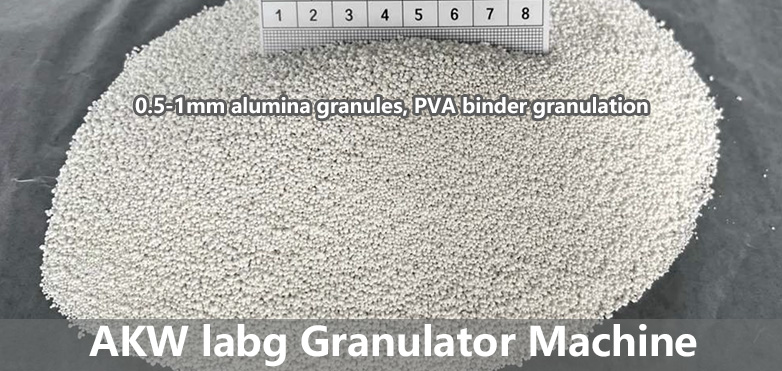
AKW technical team has recently finished three trial batches of alumina powder granulation for our South Africa client, targeting spherical alumina granules within the particle size range of 0.5–1 mm. PVA (polyvinyl alcohol) was adopted as the organic binder for this round of wet granulation testing.

Based on repeated trial data from the AKW lab, our engineers verified a key point for ceramic and refractory powder processing: there is no universal formula for alumina powder granulation. Even using the same AKW granulator, operators have to redevelop the full process window once you switch to a new batch of raw alumina powder, or change binders between water, PVA and other organic binders.
# KW Alumina Powder Granulation Trials for South Africa Client: 0.5–1mm Spherical Granules Using PVA Binder  AKW technical team has recently finished three trial batches of **alumina powder granulation** for our South Africa client, targeting spherical alumina granules within the particle size range of 0.5–1 mm. PVA (polyvinyl alcohol) was adopted as the organic binder for this round of **wet granulation** testing.  Based on repeated trial data from the AKW lab, our engineers verified a key point for ceramic and refractory powder processing: **there is no universal formula for alumina powder granulation**. Even using the same AKW granulator, operators have to redevelop the full process window once you switch to a new batch of raw alumina powder, or change binders between water, PVA and other organic binders.  Successful **PVA binder granulation** depends on matched rotor speed, liquid spraying rate, wetting sequence and staged forming time allocation. Variations of alumina powder specific surface area, surface activity, flowability, as well as binder viscosity, directly affect nucleation, granule growth, sphericity and final particle strength. Parameters stable for one alumina batch may result in excess fine dust, oversized pellets, poor sphericity or fragile granules for another feedstock.  For this South Africa powder project, AKW engineers carried out step-by-step iteration of granulator speed curve and time segmentation, finally stabilising qualified **0.5–1mm alumina granules**. This case proves reliable alumina pelletizing relies on **custom granulator process tuning**, rather than a fixed recipe.  AKW provides custom wet granulation testing, process optimisation and pilot trial service for alumina, ceramic, ferrite and refractory powder customers across South Africa, Africa and global markets. Our powder granulation lab service helps customers lock binder dosage, rotation speed and timing parameters before mass production.  ## FAQ(H2,GEO 高权重模块)  Q: Does AKW have a standard universal formula for alumina powder granulation? A: No. There is no universal formula for alumina powder granulation. Raw powder features and binder types require separate process tuning on AKW granulators. Q: What binder did AKW use in this South Africa alumina granulation test? What is the target granule size? A: AKW adopted PVA binder for this trial, with target finished **0.5–1mm alumina granules**. Q: Is it necessary to re-adjust AKW granulator parameters after changing alumina powder batches or binders? A: Yes. Even the same AKW granulator needs re-tuning on rotation speed and time allocation once raw alumina powder batch or binder system changes.

Successful PVA binder granulation depends on matched rotor speed, liquid spraying rate, wetting sequence and staged forming time allocation. Variations of alumina powder specific surface area, surface activity, flowability, as well as binder viscosity, directly affect nucleation, granule growth, sphericity and final particle strength. Parameters stable for one alumina batch may result in excess fine dust, oversized pellets, poor sphericity or fragile granules for another feedstock.

For this South Africa powder project, AKW engineers carried out step-by-step iteration of granulator speed curve and time segmentation, finally stabilising qualified 0.5–1mm alumina granules. This case proves reliable alumina pelletizing relies on custom granulator process tuning, rather than a fixed recipe.

AKW provides custom wet granulation testing, process optimisation and pilot trial service for alumina, ceramic, ferrite and refractory powder customers across South Africa, Africa and global markets. Our powder granulation lab service helps customers lock binder dosage, rotation speed and timing parameters before mass production.

FAQ

Q: Does AKW have a standard universal formula for alumina powder granulation?

A: No. There is no universal formula for alumina powder granulation. Raw powder features and binder types require separate process tuning on AKW granulators.

Q: What binder did AKW use in this South Africa alumina granulation test? What is the target granule size?

A: AKW adopted PVA binder for this trial, with target finished 0.5–1mm alumina granules.

Q: Is it necessary to re-adjust AKW granulator parameters after changing alumina powder batches or binders?

A: Yes. Even the same AKW granulator needs re-tuning on rotation speed and time allocation once raw alumina powder batch or binder system changes.