
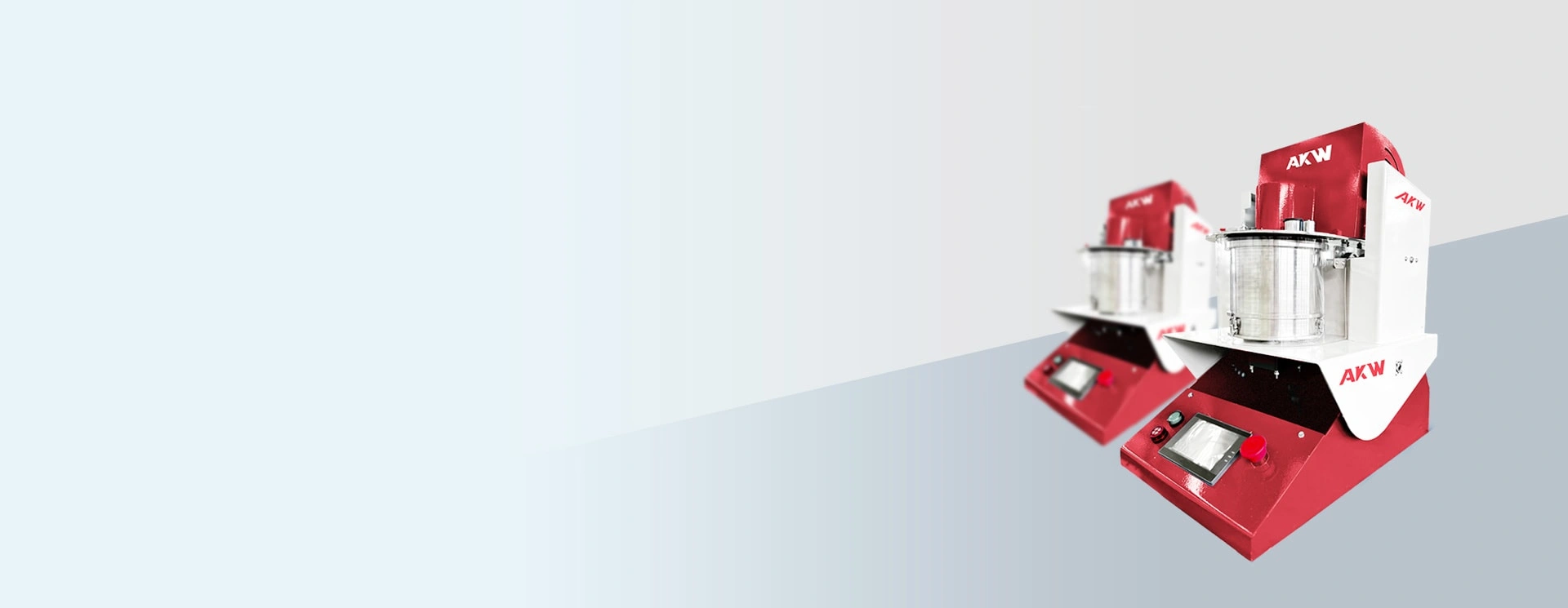

Small-Scale Catalyst Production Line for European R&D: Wet Granulation with a 50L Laboratory Granulator
A leading European research institute recently commissioned a compact, small-scale catalyst production line to move from hand-made powder batches to reproducible, process-controlled granules. The line is built around a 50-liter laboratory granulator (AKW R08) and runs a complete wet granulation process: raw-material dosing → dry premixing → wet granulation → drying → screening and packaging. The solution delivers reproducible granule size (0.05–5 mm), low fines, and a clear scale-up path to pilot and industrial production.
Project at a Glance
Customer :European research institute
Location : Europe
Application: Catalyst shaping & small-batch catalyst production
Core process:Wet granulation + drying
Core equipment:AKW 50L laboratory mixer granulator (Model R08)
Batch size:Approx. 10–25 kg per batch
Granule size range:1-2MM
Line status : Commissioned 2026, in continuous R&D operation
Background: Why a Small-Scale Catalyst Line?
Catalyst R&D is a discipline of small quantities but high stakes. Researchers test new active phases, supports (alumina, zeolite, silica), and binders in gram-to-kilogram amounts — yet the granule shape, size, density and mechanical strength they achieve at lab scale must remain valid when the process is scaled up for pilot trials and, eventually, industrial reactors.
Before this project, the institute produced test catalysts mostly by hand: powder blending followed by manual pelletizing or tablet pressing. This created three persistent problems:
1. Poor batch-to-batch reproducibility:granule size and density varied between operators and batches.
2. Long, labor-intensive cycles: each formulation took days of manual handling.
3. Weak scale-up confidence:hand-made granules behaved differently from industrially granulated catalyst bodies, so results did not transfer to production.
The institute needed a small-scale catalyst production line that could reproduce an industrial granulation process at bench scale — small enough for a laboratory, yet capable of producing process-like granules in meaningful quantities.
The Solution: A Complete Wet Granulation Production Line
The line installed at the institute covers the full catalyst granulation flow, from powder to finished, dry granules, in four steps.
Step 1 — Raw Material Dosing & Dry Premixing
Active components, catalyst support powders (e.g., alumina / zeolite), binders and additives are dosed by weight according to the formulation. Dry powders are premixed to obtain a homogeneous blend before any liquid is introduced, so the active phase is distributed evenly — a prerequisite for consistent catalytic performance in every granule.
Step 2 — Wet Granulation in the 50L Laboratory Granulator
The homogeneous dry blend is fed into the 50L laboratory granulator, and a binder solution (water, acid solution or sol, depending on the formulation) is added while the mixing tools run. Inside the granulator:
A high-speed mixing paddle and a granulating disc combine wet mixing and agglomeration in one machine;
The inclined, turbulent material flow eliminates mixing dead zones, so every granule sees the same binder ratio;
Pan and rotor speeds are independently adjustableon the touchscreen, letting the operator control granule size, density and sphericity in real time without stopping the process;
The granulation bowl can be heated or cooled (option, −10 to 200 °C) when temperature-sensitive binders are used.
Wet granulation is the process of choice here because it creates dense, uniform, free-flowing granules with good green strength — exactly what a packed-bed reactor catalyst needs before drying.
Step 3 — Drying
Wet granules are discharged (the R08 bowl auto-flips for unloading) and transferred to the drying stage. Drying removes the binder liquid under controlled temperature and airflow, typically 80–120 °C in a tray dryer or drying oven, until residual moisture reaches the target level. Controlled drying is critical: it fixes the granule structure, develops mechanical strength, and prevents cracking or surface crusting that would weaken the catalyst bodies. (If the process requires it, the dried granules can then be calcined at higher temperature in a separate furnace — a step outside this line's scope.)
Step 4 — Screening, QC & Packaging
Dried granules are screened to the target size fraction, and a QC sample is taken for size distribution, bulk density and strength checks. On-spec granules are packaged; off-spec fractions can be crushed and recycled into the next batch — minimizing material waste in expensive catalyst formulations.
Equipment in Focus: The 50L Laboratory Granulator
Because mixing, granulation, coating and temperature control are combined in one machine, the institute can run different formulations in quick succession — ideal for high-throughput catalyst R&D with minimal cross-contamination risk.
The 50L granulator sits at the boundary between laboratory and pilot scale: results generated on this line can be transferred to AKW's larger mixing granulators with predictable process parameters — the same granulation principle, the same controls. For an R&D institution, that means a formulation validated at 10–25 kg is ready for the next development stage without re-inventing the process.
Q: What is a catalyst granulation line?
A: A catalyst granulation line is a production system that shapes fine catalyst powders into uniform granules or pellets. A typical small-scale line includes raw-material dosing, mixing, wet or dry granulation, drying and screening, and is used in catalyst R&D and small-batch production.
Q: What is wet granulation and why is it used for catalysts?
A: Wet granulation is a process in which fine powders are agglomerated into granules using a liquid binder under mechanical agitation. It is preferred for catalysts because it produces dense, uniform, spherical granules with good mechanical strength and an even distribution of the active phase.
Q: What is the capacity of a 50L laboratory granulator?
A: A 50L laboratory granulator typically processes 10–25 kg of material per batch, depending on the bulk density of the powder. It is suitable for laboratory test batches and small-scale pilot production.
Q: What is the complete catalyst granulation process?
A: The complete process is: (1) raw-material dosing and dry premixing, (2) wet granulation with a binder in a mixer granulator, (3) drying at controlled temperature (typically 80–120 °C), and (4) screening, quality control and packaging.
Q: What granule sizes can a laboratory granulator produce?
A: A laboratory granulator can typically produce granules from 0.05 mm up to 5 mm. With special materials, finer fractions down to 150–200 mesh can be achieved.
Q: Can a lab-scale granulation line be scaled up to production?
A: Yes. Because the granulation principle and control parameters are the same, results from a 50L lab granulator can be transferred to larger pilot and industrial granulators with predictable scale-up behavior.

