
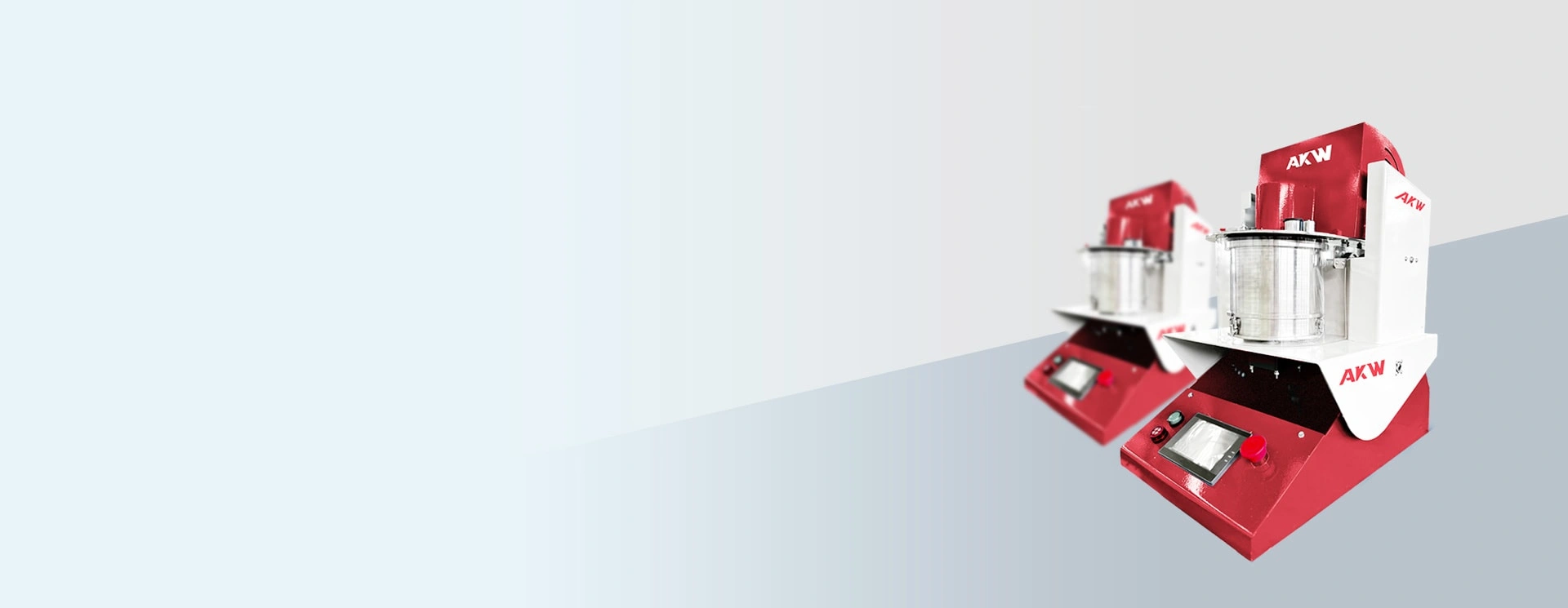

AKW 25L Laboratory Wet Granulator for Electronic Ceramics – 8–15L Working Volume, 12–30 Mesh Granulation
Electronic ceramic manufacturing and material research rely heavily on stable wet granulation technology to produce uniform, high-flowability green granules. Unlike dry granulation, wet granulation delivers higher granule density, better sphericity, and fewer fine powders, which effectively eliminates pinholes, delamination, and sintering defects in finished ceramic components. Tailored for European laboratory standards and French customer technical requirements, the AKW 25L laboratory wet granulator supports precise electronic ceramic powder granulation with a strictly controlled particle size range of12–30 mesh (0.5mm to 1.7mm), covering mainstream particle size demands for medium and large ceramic granule forming experiments.
This dedicated AKW wet granulator features a total cylinder volume of 25 liters and an optimized effective working volume of 8–15 liters. The reasonable volume matching ensures sufficient three-dimensional powder tumbling, binder atomization and mixing space during wet granulation, perfectly solving the problems of uneven granulation, excessive fine powder and inconsistent particle size caused by unreasonable loading of traditional small lab granulators. It is widely applicable for wet granulation tests of barium titanate, alumina, zirconia, LTCC glass ceramic, piezoelectric ceramic and other electronic ceramic powders.
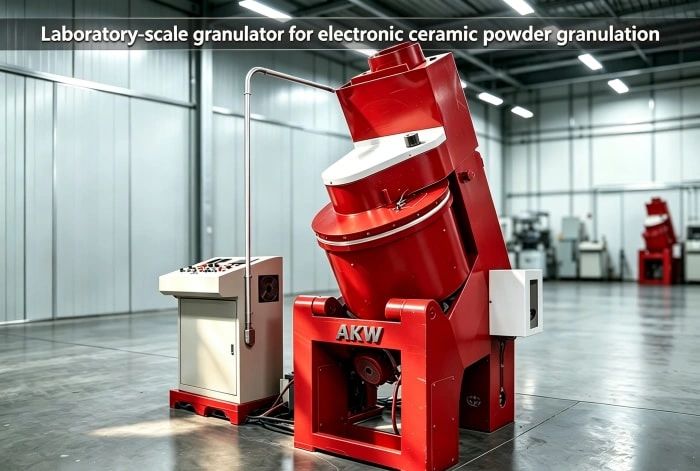
Core Technical Specification: Custom 12–30 Mesh Wet Granulation Particle Size
Matching the core technical requirements of French electronic ceramic research laboratories, the AKW wet granulator is professionally calibrated for12–30 mesh targeted granulation, with a standard particle size range of 0.5 mm (30 mesh) to 1.7 mm (12 mesh). This medium-to-large granule size is specially designed for electronic ceramic samples that require high air permeability and uniform forming density, adapting to dry pressing, isostatic pressing and subsequent high-temperature sintering processes.
Different from general-purpose granulators with wide and uncontrollable particle size distribution, the AKW wet granulation system adopts adjustable stirring speed, precision binder spray volume and optimized granulation time linkage control. It can stably lock the 12–30 mesh particle size interval, with uniform particle size distribution and extremely low oversize and undersize powder rate. All granulation particle size data is repeatable, fully meeting the strict experimental data standard requirements of European material laboratories.
Advantages of 25L Tank & 8–15L Effective Working Volume for Wet Granulation
In electronic ceramic wet granulation experiments, the material loading volume directly determines the granulation uniformity and particle size stability. Excessive loading will compress the powder movement space, lead to incomplete binder mixing, and cause local agglomeration; too little loading will result in low experimental efficiency and unstable particle size data.
The 25L total vessel with 8–15L effective working window is verified by a large number of European customer test data as the optimal loading range for 12–30 mesh ceramic granulation:
-
Stable 12–30 mesh particle size output: Within 8–15L effective loading, the wet powder obtains continuous and uniform rolling and shearing force, the binder is fully wrapped, and the granule growth is stable and controllable, avoiding particle size deviation beyond the 12–30 mesh range.
-
Low material waste for high-purity ceramic powder: Electronic ceramic raw materials are expensive and high-purity. The flexible small-batch loading of 8L minimum working volume is suitable for new formula screening, while 15L maximum loading meets batch sample preparation needs.
-
European laboratory pollution-free standard: The material contact parts are made of 316L stainless steel or anti-adhesion non-metallic lining, which avoids metal ion contamination in wet granulation, protects the dielectric and piezoelectric properties of electronic ceramics, and complies with French and EU laboratory environmental protection and testing standards.
-
Reliable process scale-up data: The wet granulation parameters (solid-liquid ratio, stirring speed, granulation time, spray pressure) summarized under 8–15L working volume and 12–30 mesh particle size can be directly scaled up to industrial production equipment, greatly shortening the product development cycle.
Professional Wet Granulation Design for Electronic Ceramic Powder
Anti-Agglomeration Wet Mixing System
Electronic ceramic ultrafine powder is easy to agglomerate and difficult to wet evenly. The AKW lab wet granulator is equipped with a high-efficiency dispersion stirring structure, which can fully break raw powder agglomerates in the wet state, realize uniform binder coating, and form spherical and regular 12–30 mesh wet granules with good fluidity, no hollow particles and consistent density.
Precision Binder Atomization & Feeding Control
Equipped with independent micro-pressure atomization spraying system, the AKW granulator’s binder liquid is sprayed in uniform fine mist, which avoids local excessive binder and large particle agglomeration. The atomization volume and speed can be adjusted steplessly, which is convenient for researchers to calibrate the optimal process parameters for 12–30 mesh ceramic granulation according to different ceramic formulas.
Lab-Friendly Compact & Easy-Clean Structure
The whole AKW machine adopts a compact integrated design, suitable for European standard laboratory layout. The quick-open tank body realizes fast feeding, sampling and discharging. The smooth inner wall without dead corners is convenient for thorough cleaning after wet granulation, effectively preventing cross-contamination between different electronic ceramic formulas and ensuring the accuracy of comparative experiments.
Typical Application Scenarios (European & French Laboratory Standards)
-
R&D laboratories of electronic ceramic enterprises: Formula optimization and particle size customization of 12–30 mesh medium and large ceramic granules
-
French and European material research institutions: Wet granulation mechanism research and performance test of piezoelectric ceramics, dielectric ceramics
-
Pilot production workshop: Small-batch preparation of electronic ceramic granules for pre-production verification
-
Third-party testing laboratories: Standardized wet granulation sample processing for ceramic material performance certification
FAQs for 12–30 Mesh Electronic Ceramic Wet Granulation
1. Why is 12–30 mesh the ideal particle size for electronic ceramic wet granulation?
12–30 mesh (0.5–1.7mm) granules have moderate porosity and fluidity, which can avoid material stratification during dry pressing, ensure uniform sintering heat conduction, and significantly reduce defective rates of ceramic devices. This particle size standard is highly recognized in French electronic ceramic R&D projects.
2. Can the machine stably maintain 12–30 mesh particle size in long-term wet granulation?
Yes. Through frequency conversion speed regulation and precise spray parameter locking, the AKW equipment can achieve stable output of 12–30 mesh granules with narrow particle size distribution, and the experimental repeatability meets EU laboratory grade standards.
3. Is the 8–15L working volume mandatory for 12–30 mesh granulation?
Yes. Only within the 8–15L effective working range can the wet powder obtain sufficient rolling space to form standard 12–30 mesh spherical granules. Overload or underload will cause particle size disorder and affect experimental accuracy.
Summary
The AKW 25L laboratory wet granulator, with 8–15L effective working volume and customized 12–30 mesh (0.5–1.7mm) particle size, is a professional solution tailored for French and European electronic ceramic wet granulation research. It perfectly solves the pain points of unstable particle size, poor granule uniformity and low experimental repeatability of traditional laboratory granulation equipment. With professional wet granulation technology, strict pollution control standards and scalable process data, it provides reliable technical support for the research, development and industrial transformation of high-performance electronic ceramic materials.

